
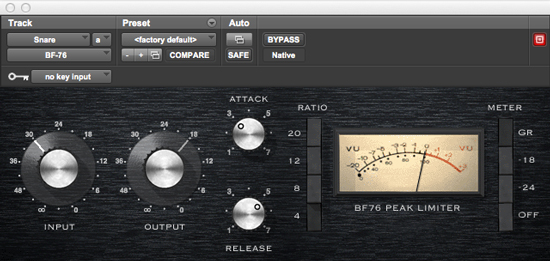
 When we hear about compressors for the first time, we think at something with some kind of “dark magic” in it, something that will make our mixes and tones better somehow, no matter the source or the settings.
We don’t know how to actually use it and this will lead us to put it on every track, guessing the type of effect we are going to get from it and hoping it will work.
Even if it’s one of the most misunderstood tool, the basic of how a compressor works are very simple actually.
Someone Is Riding The Fader For You
Using just 3 words, it does automatic volume riding. That’s it! Pretty easy, isn’t it?
A compressor does the same thing we can do manually by moving the fader up and down to keep our track at a consistent level, a very similar thing to what happens when we write a volume automation to make an element sit better in the mix.
It is used to limit the dynamic range of a track (the difference between louder and softer parts), so it can play along with other instruments without level drops or spikes ruining the listening experience.
It will give a track the consistency and the “glue” it needs to sound tight and cohesive.
All of this will be done on autopilot by the compressor. Amazing, right? But…
From Great Power Comes Great Responsibility
Unfortunately, chances are you won’t get anything good from a compressor if you first don’t set it up the way it needs to get the job done. It can do more harm than good if used incorrectly.
Think about this: you need a friend to help you with your volume automations…You need to tell him how to react to volume changes, right? Same with a compressor.
To make everything work, the meaning of Threshold, Ratio , Attack, Release and Make Up Gain must be set in stone in your head.
Understand this and you’ll have the full power of compression at your fingertips, no matter if you’re going to use a plugin or a vintage outboard unit. They work exactly the same way.
Threshold
Question: “When should the compressor come into play?”
You give the compressor a limit, a “point of action”, a threshold level.
When the incoming signal crosses the threshold, the compressor will start to work and will keep compressing till the signal level stays above it. Otherwise, it will do absolutely nothing.
You need to set the threshold depending on the actual level of the track that’s feeding the compressor (say your snare drum). It strictly depends on how loud your instrument is playing on that channel and its internal dynamics.
Even if the signal is being reduced by compression, the compressor itself will never reduce it below the threshold. In other words, the signal is kept at at a level that is always above (or equal to) the threshold. The only moments when the signal stays below the threshold is when its actual level is lower than that (and again, no compression is happening in that case!).
Unfortunately, the threshold value alone is not enough to tell the compressor “how much it should compress”. In fact, that’s a combination of both the threshold level and another parameter, called Ratio.
Ratio
Question: “How much will the compressor reduce (compress) the incoming signal?”
This thing is set by using a ratio between input (uncompressed signal) and output (compressed signal) of the compressor.
With a 1:1 ratio (read 1 to 1 ratio), there’s no compression. With a 2:1 ratio instead, every time the signal goes above the threshold, it is reduced by 50%.
Higher ratios will tell the compressor to squeeze the signal more and, with ratios greater than 8:1, we are basically limiting the signal to the threshold level.
To be continued in Part 2…

Easy and straight to the point. Definitely worth reading!
Many thanks! Glad you liked it 🙂